Budgeting
What to Do When Your Paycheck Doesn't Cover the Bills
A practical order of operations when this payday cannot cover everything due before the next one: measure the gap, rank must-pay bills, short-term fixes, and how to stop the same crunch next month.
On this page
- First: separate "this paycheck is short" from "I never have enough"
- Step 1: Write the next 14 days on one page
- Step 2: Rank what must be paid now
- Step 3: Use the short-term toolkit (in order)
- Step 4: Protect the next paycheck on purpose
- Step 5: If the whole month is short, do a full reset
- Worked example: a larger gap
- What not to do when the paycheck is short
- Build a repeating paycheck system
- When to get outside help
A paycheck that does not cover the bills due before the next payday is one of the most stressful money problems. It is also more common than people admit, especially on biweekly pay when rent, a car payment, and a utility bill land in the same two-week window. The goal of this guide is not to shame the shortfall. It is to give you a clear order of operations: see the real gap, protect the must-pay items, move what you can, and build a paycheck plan so the same crunch is less likely next month.
The figures below are hypothetical examples for teaching. Your rent, wages, and due dates will differ.
First: separate "this paycheck is short" from "I never have enough"
Those are related but not the same problem.
- This paycheck is short means the bills due in the next 14 days add up to more than the deposit that just arrived (or is about to arrive). Another paycheck in two weeks may be fine.
- The month is short means even after both (or all) paychecks, income does not cover the full month of necessary expenses.
You need different moves for each. Start by listing what is due before the next payday. If that list alone is bigger than this paycheck, you have a timing problem, a size problem, or both.
Step 1: Write the next 14 days on one page
Open a notes app or a blank sheet and list:
- Paycheck amount (take-home, after taxes)
- Every bill or payment due before the next payday, with the due date and amount
- Groceries and gas for those same days (use a realistic number, not zero)
- Minimum debt payments that will be late if skipped
Add them up. Subtract from the paycheck. The result is your gap (negative) or leftover (positive).
Hypothetical example:
Sam is paid $1,420 take-home every other Friday. Next payday is in 14 days. Due before then:
| Due | Item | Amount |
|---|---|---|
| --- | --- | --- |
| Mon | Rent (remaining after last partial) | $900 |
| Wed | Car payment | $310 |
| Fri | Electric | $145 |
| Anytime | Groceries + gas (estimate) | $160 |
| Total needed | $1,515 | |
| Paycheck | $1,420 | |
| Gap | −$95 |
Sam is $95 short for this window. That is painful but solvable with small moves. A $500 gap needs bigger ones.
For a reusable layout, see how to budget biweekly paychecks when bills are monthly and how to make a bill calendar.
Step 2: Rank what must be paid now
Not every due date has the same consequence. In rough order for many households:
- Housing (rent or mortgage) — late fees, notices, and credit damage escalate quickly.
- Utilities that can shut off and court-ordered payments (child support, for example).
- Transportation you need for work (car payment if repossession is a real risk, or the transit pass that gets you to the job).
- Insurance that keeps you legal (auto) or covered for health if a lapse would be costly.
- Minimum payments on credit cards and loans — late fees and credit-score damage matter, but usually after housing and utilities.
- Subscriptions and nonessentials — pause these first.
This ranking is a practical triage, not a moral ranking. If you are unsure about your rights when you cannot pay rent or a utility, check official state resources or a local legal aid clinic. The Consumer Financial Protection Bureau (CFPB) publishes plain-English guides on dealing with debt collectors and credit cards at consumerfinance.gov.
Step 3: Use the short-term toolkit (in order)
Work down this list until the gap is closed or as small as possible:
A. Cut or pause anything that is not required this week. Streaming, extra shopping, restaurant food, optional apps. Free up cash that is about to leave the account.
B. Move a due date. Call the card issuer, lender, or utility and ask whether the due date can shift to after your next payday. Many will do this once; some will not. Ask early, before the day it is late.
C. Ask about hardship options. Some utilities offer payment plans. Some lenders allow a short deferral. Get any agreement in writing (email is fine).
D. Use a backup cash source carefully. That might be a small emergency fund, selling something you already planned to sell, or a one-time extra shift. Avoid stacking new high-interest debt to pay old debt unless you have a written payoff plan for the new balance.
E. Talk to anyone you share bills with. A roommate, partner, or co-signer may be able to cover a slice this cycle if you cover more on the next paycheck. Be specific about amounts and dates.
F. Contact assistance only for true hardship. Local 211 services, utility assistance, and nonprofit counselors can help in some areas. Use official .gov or well-known nonprofit channels; ignore random "grant" ads on social media.
In Sam's $95 example, pausing two subscriptions ($30), trimming groceries by $40, and moving a $40 medical bill payment to the following week closes the gap without a loan.
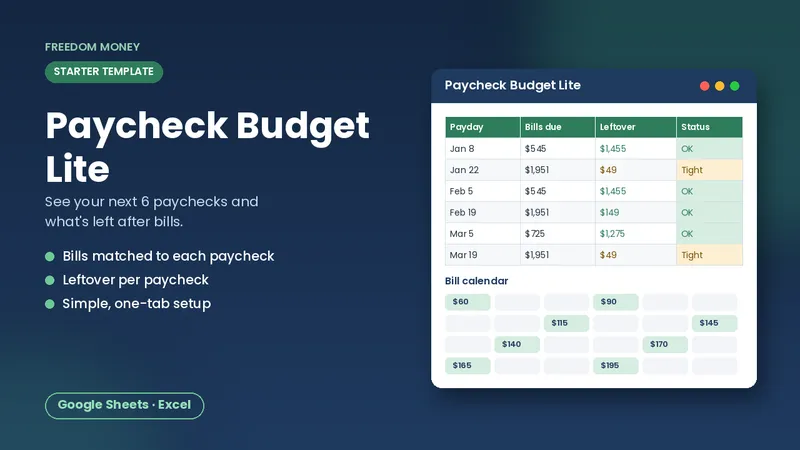
Free: Paycheck Budget Lite
A simple starter spreadsheet for Google Sheets or Excel. List your take-home pay and bills and see what each paycheck has left. Free, instant download.
Download the free templateStep 4: Protect the next paycheck on purpose
Surviving this week is not the whole job. The same pile-up will return unless you change how bills map to paychecks.
- Put every payday and every due date on one calendar for the next 60 days.
- Assign each bill to the paycheck that arrives before it is due.
- Add up each paycheck's load. If paycheck A is always overloaded and paycheck B is light, ask creditors to move due dates, or set aside money from B toward A's bills.
Hypothetical fix for Sam:
After the crunch, Sam lists both paychecks in the month. Paycheck 1 (1st Friday) was carrying rent + car + electric. Paycheck 2 only had phone ($70) and a credit card minimum ($50). Sam asks the auto lender to move the due date by 10 days (approved). Now car payment sits on paycheck 2. Paycheck 1 drops by $310 and is no longer short. Sam also starts a tiny buffer: $25 from each light paycheck into savings so the next surprise has a cushion. For buffer math, see building an emergency fund on a biweekly paycheck.
Step 5: If the whole month is short, do a full reset
When both paychecks together cannot cover rent, food, utilities, and minimum debt payments, timing tricks are not enough. You need a full budget pass:
- List take-home income for a normal month (use the lower average if hours change).
- List must-pay costs only.
- Compare. The difference is the structural gap.
- Cut costs you control, increase hours or side income if that is realistic, or both.
- For debt that no longer fits, look at nonprofit credit counseling and know your rights; the FTC and CFPB warn about debt-relief scams that charge high fees upfront.
A zero-based approach (every dollar gets a job) helps you see the gap clearly: zero-based budgeting for beginners. If income jumps around with overtime, use budgeting with irregular pay.
Worked example: a larger gap
Hypothetical: Riley brings home $1,100 this Friday. Bills before the next payday total $1,480 (rent share $700, childcare $400, phone $80, card minimum $100, food/gas $200). Gap: −$380.
Order of operations Riley tries:
- Pause gym and two subscriptions → frees $55.
- Ask childcare if half can be paid after next payday → they allow $150 to wait (written text confirmation).
- Call the card issuer → due date moved 7 days; the $100 minimum now falls after next payday.
- Remaining gap: $380 − $55 − $150 − $100 = $75.
- Use $75 from a small emergency savings account and note a plan to rebuild it from the following three-paycheck month.
Riley then rebuilds the calendar so childcare and rent are never both due from the same light paycheck again.
What not to do when the paycheck is short
- Ignore the bill and hope. Late fees and missed-payment reports make the next month harder.
- Take the first online "payday loan" ad. Costs are often extremely high; read any offer using official consumer resources first.
- Pay only the loudest collector. Housing and essential utilities usually come first.
- Drain every account to zero with no plan for food until next payday. Leave a small, deliberate amount for absolute necessities.
- Hide the problem from a partner who shares the bills. Surprises create bigger fights than honest numbers.
Build a repeating paycheck system
Once the immediate fire is out, spend one quiet hour on a standing plan:
- List all recurring bills (12 months of statements so quarterly and yearly costs appear).
- Map them to paychecks by due date.
- Give each paycheck a simple job list: "Pay these, save this much, leftover for variable spending."
- Review every payday for 10 minutes: what cleared, what is due in 7 days, what changed.
A spreadsheet that flags a paycheck as short or tight before payday is easier than discovering the gap when rent is already due. The Biweekly Paycheck Budget plans all 26 paychecks and warns when a paycheck is short. To try the idea free, start with the Paycheck Budget Lite or the site's free budget template.
When to get outside help
Seek nonprofit or legal help sooner if you have an eviction notice, utility shutoff notice, wage garnishment, or debt collectors contacting you about debts you do not recognize. Prefer counselors affiliated with known nonprofit networks and information from consumerfinance.gov or ftc.gov. Avoid anyone who guarantees they can erase debts for a large upfront fee.
A short paycheck is a signal, not a verdict. Measure the gap, protect the essentials, move what you can, then fix the calendar so the next deposit is assigned before it arrives.
This article is general education, not financial advice. Always check amounts and due dates against your actual statements.
Frequently asked questions
What should I pay first when my paycheck is short?
Usually housing first, then utilities that can shut off and other required payments, then transportation you need for work, then minimum debt payments. Pause subscriptions and optional spending before you skip rent.
How do I know if it is a timing problem or a real income problem?
List bills due before the next payday and compare them to this paycheck. If only that window is short but the full month of income covers the full month of needs, it is mostly timing. If the whole month still falls short, income or expenses need a bigger change.
Can I change a bill due date?
Often you can ask. Many card issuers, lenders, and some utilities will move a due date, especially if you ask before the payment is late. It is not guaranteed, so call early.
Should I use a credit card to cover a short paycheck?
Only with a clear plan to repay it from a specific future paycheck, and only after you have cut optional spending and asked about due-date changes. New high-interest debt can make the next month worse.
What tools help prevent the next short paycheck?
A bill calendar plus a paycheck-by-paycheck budget that assigns each bill to the deposit that arrives before it is due. Start free with Paycheck Budget Lite, or use a full biweekly paycheck budget spreadsheet if you want all 26 paychecks planned.
This guide is general educational information, not financial, tax, legal, or insurance advice. Examples are illustrations, not predictions. See our disclaimer.