Budgeting
How to Budget With Irregular Pay, Overtime, or Changing Hours
Budget with irregular income or overtime using a baseline paycheck, a priority list for extra money, and a buffer account that smooths out uneven pay.
On this page
- Step 1: Find your baseline paycheck
- Step 2: Build your budget on the baseline only
- Step 3: Decide in advance where extra money goes
- Step 4: Create a buffer account to smooth things out
- A worked example
- Track overtime and extra pay separately
- Tips for specific situations
- Watch for withholding on large paychecks
- Mistakes to avoid
- The bottom line
- Setting a seasonal baseline
- Review your baseline every few months
If your paycheck changes from one period to the next because of overtime, tips, commissions, shift work, or changing hours, a standard budget can feel useless. You plan around $1,600 and get $1,250, or you get $2,100 and the extra disappears without a trace. The solution is not a more complicated budget. It's a budget built around a baseline, plus a clear plan for anything above it.
Step 1: Find your baseline paycheck
Look at your last six to twelve paychecks (take-home, not gross). Your baseline is a conservative number you can count on in most periods. Two common ways to pick it:
- The low paycheck method: use your lowest normal paycheck from the last few months (ignore one-off unusual drops like unpaid leave).
- The average-minus method: average your recent paychecks and subtract a safety margin, like 10–15%.
Either way, the goal is a number you hit almost every time.
Step 2: Build your budget on the baseline only
Assign your bills, groceries, gas, minimum debt payments, and small savings to the baseline paycheck amount. If you're paid biweekly, use the per-paycheck method from how to budget biweekly paychecks. If the baseline can't cover the essentials, that's important information. It tells you to trim costs, adjust due dates, or plan the buffer first.
Step 3: Decide in advance where extra money goes
Anything above the baseline is "extra." Without a plan, it gets spent. Write a priority list now, while you're calm, for example:
- Top up the buffer account until it's full (see Step 4)
- Set aside taxes if any of the extra is side income
- Extra payment on the priority debt
- Savings goals with deadlines
- Fun money (pick a percentage, like 10% of extra)
When a big paycheck arrives, you just follow the list.
Step 4: Create a buffer account to smooth things out
A buffer (sometimes called a "smoothing" account) is the key tool for irregular pay. It works like this:
- Big paychecks: the amount above baseline goes into the buffer until it reaches its target.
- Small paychecks: you pull the shortfall from the buffer to bring it up to baseline.
This turns uneven pay into a steady baseline in your checking account. A useful buffer target is one baseline paycheck, then grow it toward a month's worth of essential expenses.
A worked example
Baseline: $1,400 per paycheck. Buffer target: $1,400.
| Paycheck | Actual pay | Above/below baseline | Buffer action | Buffer balance |
|---|---|---|---|---|
| 1 | $1,650 | +$250 | Add $250 | $250 |
| 2 | $1,300 | −$100 | Pull $100 | $150 |
| 3 | $1,900 | +$500 | Add $500 | $650 |
| 4 | $1,400 | $0 | None | $650 |
| 5 | $1,750 | +$350 | Add $350 | $1,000 |
Every paycheck, the household spends a steady $1,400 while the buffer absorbs the swings. Once the buffer reaches $1,400, extra money moves down the priority list to debt and savings.
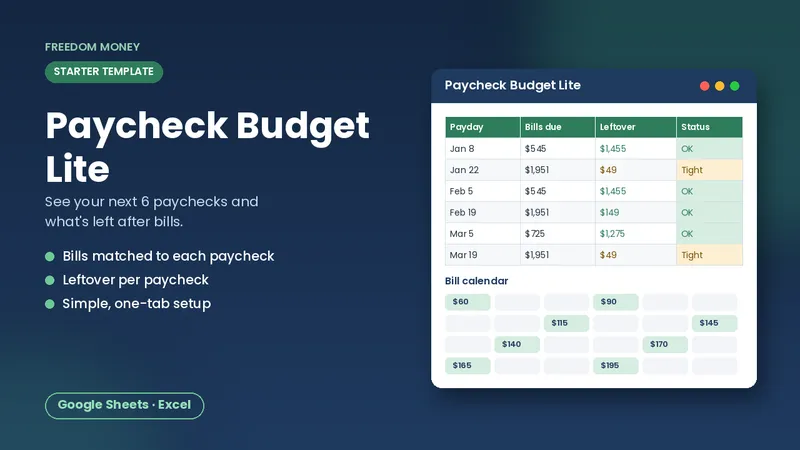
Free: Paycheck Budget Lite
A simple starter spreadsheet for Google Sheets or Excel. List your take-home pay and bills and see what each paycheck has left. Free, instant download.
Download the free templateTrack overtime and extra pay separately
Add a column to your budget for "actual pay" next to the baseline for each paycheck. This shows patterns: maybe overtime is reliable in summer and slow in winter. Over time, you can set a seasonal baseline. Our Biweekly Paycheck Budget lets you override any single paycheck's amount without breaking the rest of the plan, which is exactly what irregular pay needs.
Tips for specific situations
- Tips and cash income: deposit cash regularly so it shows up in your records, and track it in your budget.
- Commission or bonus-heavy jobs: budget on base pay only. Treat commissions as extra and follow the priority list.
- Seasonal work: in high-earning months, fund the buffer aggressively for the slow months.
- Gig or side work: set aside taxes first. See tracking side income and taxes.
Watch for withholding on large paychecks
Big overtime checks can have more tax withheld than you expect because payroll systems may calculate withholding as if every paycheck were that size. The money isn't lost, since withholding is reconciled when you file, but it can make take-home pay less predictable. The IRS Tax Withholding Estimator can help you check your W-4 if your pay changes a lot.
Mistakes to avoid
- Budgeting on your best paycheck. You'll be short most of the time.
- Spending the buffer. It isn't extra money; it's next month's baseline.
- No plan for extra money. Decide in advance, or it disappears.
- Forgetting irregular expenses. Add sinking funds for yearly costs.
The bottom line
Irregular pay becomes manageable when you budget on a reliable baseline, park the extra in a buffer during good periods, and draw from it in slow ones. Once the buffer is full, a clear priority list sends every extra dollar toward debt and savings. The result is steady spending on unsteady income.
Setting a seasonal baseline
If your pay follows a pattern, like busy summers and slow winters, one baseline for the whole year may be too low in busy months and too high in slow ones. Look back at the last 12 months of pay and group them into busy and slow periods. Set a baseline for each period. Then, before a slow period starts, make sure the buffer holds enough to cover the gap between your normal spending and the slow-season baseline. That way, the busy months fund the slow ones on purpose instead of by luck.
Review your baseline every few months
Your pay pattern will change over time: a raise, a new schedule, or more or less overtime. Every three months, look at your recent paychecks again and ask whether the baseline still fits. If you've been above baseline almost every period and the buffer is full, you can raise the baseline a little. If you've been dipping into the buffer often, lower it. Small, regular adjustments keep the plan realistic without starting over, and they keep the buffer doing its real job: smoothing, not covering a permanent gap.
Frequently asked questions
How do I budget if my income changes every paycheck?
Pick a conservative baseline paycheck, budget only on that amount, and send anything above it to a buffer account and a pre-decided priority list.
What is a buffer account?
A separate savings account that absorbs extra pay in good periods and tops up small paychecks to your baseline in slow ones.
Should I budget with overtime?
Usually not. Budget on base pay and treat overtime as extra money with a planned job.
This guide is general educational information, not financial, tax, legal, or insurance advice. Examples are illustrations, not predictions. See our disclaimer.