Budgeting
Three-Paycheck Months: What They Are and What to Do With the Extra Paycheck
If you're paid biweekly, two months a year usually have three paydays. Here's how to find them on the calendar and a simple plan for using that extra paycheck well.
On this page
- Why three-paycheck months happen
- How to find your three-paycheck months
- Step 1: Make sure it really is "extra"
- Step 2: Choose one main job for it
- Step 3: Decide the split before payday
- Step 4: Keep your regular spending the same
- A worked example
- Using three-paycheck months to fix a tight budget
- What if you're paid weekly or twice a month?
- Put it on the calendar
- The bottom line
- Planning both extra paychecks for the year
If you're paid every two weeks, a couple of times a year you'll notice a month with three paydays instead of two. These "three-paycheck months" are one of the best budgeting opportunities most people waste. This guide explains why they happen, how to find yours, and how to plan the extra paycheck before it arrives.
Why three-paycheck months happen
A year has 52 weeks, so a biweekly schedule produces 26 paydays in most years. Twelve months with two paychecks each is only 24. The two leftover paychecks have to land somewhere, and they land in months long enough to fit three Fridays (or whatever your payday is) spaced 14 days apart. In some years the calendar works out to 27 paydays, which means three such months.
If your monthly budget is built on two paychecks, those third paychecks have no bills assigned to them. That's what makes them powerful: the bills are already covered by the other two.
How to find your three-paycheck months
- Write down your first payday of the year.
- Add 14 days repeatedly until you've listed every payday through December (a spreadsheet does this instantly: put the date in A1, type
=A1+14in A2, and drag down). - Count paydays per month. Any month with three is your target.
Do this in January so you can plan the whole year at once.
Step 1: Make sure it really is "extra"
Before you plan the money, double-check two things. First, confirm your budget truly runs on two paychecks per month. If you've been quietly relying on the third paycheck to catch up on bills, the first job is to fix that gap. Second, check whether any yearly bills fall in that month, like car registration or insurance. If so, the third paycheck can cover them, and that's a perfectly good use.
Step 2: Choose one main job for it
Splitting the extra paycheck across six goals usually means none of them moves much. Pick one primary job and maybe one small treat. Common jobs:
- Build a one-paycheck buffer. Put the whole thing in a separate savings account. Once you have a cushion equal to one paycheck's worth of bills, due-date timing stops being stressful.
- Kill a small debt. An extra paycheck can wipe out a store card or medical bill entirely. That frees up its minimum payment for every future month, which is the idea behind the debt snowball.
- Fund a big yearly cost. Holidays, back-to-school, car maintenance, or annual subscriptions.
- Start or top up an emergency fund. See how to build an emergency fund on biweekly pay.
- Catch up on retirement or other long-term savings, if your short-term basics are already handled.
Step 3: Decide the split before payday
Write it down: for example, "80% to the buffer account, 20% to a family dinner out." When the money arrives, move it the same day. The longer it sits in checking, the more likely it disappears into normal spending.
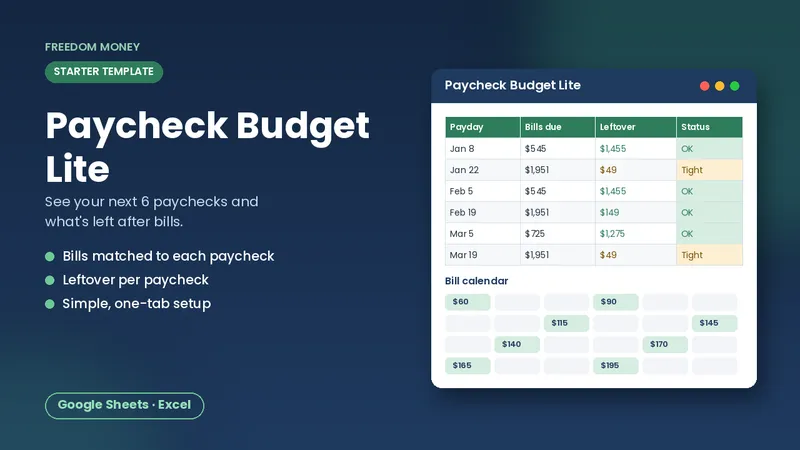
Free: Paycheck Budget Lite
A simple starter spreadsheet for Google Sheets or Excel. List your take-home pay and bills and see what each paycheck has left. Free, instant download.
Download the free templateStep 4: Keep your regular spending the same
A three-paycheck month is not a month with three paychecks' worth of groceries. Keep every-paycheck categories, like groceries and gas, at their normal amount for the third check or redirect them too. If you do spend some of it on everyday needs, plan the amount on purpose.
A worked example
Say take-home pay is $1,500 per paycheck and the budget is built on two per month. In a three-paycheck month, the third check is $1,500 with nothing assigned to it except, perhaps, that period's groceries and gas of $300. That leaves $1,200 with no job. A plan might look like:
| Job | Amount |
|---|---|
| Starter buffer savings | $900 |
| Extra payment on store card | $250 |
| Planned fun | $50 |
Repeat that in the second three-paycheck month and you've moved meaningfully on two goals without changing your normal monthly budget at all.
Using three-paycheck months to fix a tight budget
If your two-paycheck months are always tight, the extra paychecks can also be used to restructure. For example, pay off a debt with a high monthly minimum so the following months have more breathing room. Or prepay something yearly that's currently billed monthly at a higher price. The goal is to make every normal month a little easier going forward.
What if you're paid weekly or twice a month?
Weekly pay creates five-paycheck months, which works the same way: four checks cover the bills and the fifth is free to plan. Twice-a-month pay (for example the 1st and 15th) has exactly 24 paychecks and no extra months, so you'd use bonuses or tax refunds the same way instead.
Put it on the calendar
The single most useful step is simply knowing when these months are. Add a reminder a week before each three-paycheck month that says "the extra paycheck already has a job." Our Biweekly Paycheck Budget lists all 26 paydays from your first payday and shows leftover per paycheck, so these months stand out on their own.
The bottom line
Three-paycheck months are predictable, which means they're plannable. Treat each one as a planned boost toward a single goal, move the money the day it arrives, and keep regular spending normal. Two well-planned extra paychecks a year can build a buffer or clear a debt without any change to your day-to-day budget.
Planning both extra paychecks for the year
Here's a simple way to plan both at once in January. Write down the two (or three) months. Next to each, write one goal and a dollar amount. For example: "March: buffer account, full paycheck minus groceries" and "August: back-to-school costs, then the rest to the store card." Then set a calendar reminder for the day before each payday so you move the money immediately. A plan made in January is much easier to follow than a decision made on payday, when there's always something tempting to spend it on.
A third paycheck is also a natural time to top up your sinking funds, the small savings pots for yearly bills like car registration or holiday gifts. The Sinking Funds Tracker shows which funds are behind so you know where the extra money helps most.
Frequently asked questions
Which months have three paychecks?
It depends on your first payday of the year. List every payday by adding 14 days at a time and count paydays per month.
How many three-paycheck months are in a year?
Usually two for biweekly pay. In years with 27 paydays, there are three.
Is it okay to spend the extra paycheck?
Yes, as long as you plan it. Many people pick one main goal, like a buffer or a debt, and set aside a small part for fun.
This guide is general educational information, not financial, tax, legal, or insurance advice. Examples are illustrations, not predictions. See our disclaimer.