Budgeting
How to Budget Biweekly Paychecks When Your Bills Are Monthly
A practical method for budgeting biweekly paychecks against monthly bills: split bills by due date, plan every-paycheck costs, and stop running short before rent.
On this page
- The core problem: timing, not just totals
- Step 1: Write down your real take-home pay
- Step 2: Sort your bills into three groups
- Step 3: Assign each monthly bill to a paycheck
- Step 4: Balance the heavy paycheck
- Step 5: Plan the every-paycheck spending
- Step 6: Give the leftover a job
- Handling the months with three paychecks
- What about when a paycheck is smaller?
- Tools that make this easier
- A sample payday checklist
- Why this works
- Keep it simple
Getting paid every two weeks while your bills arrive once a month is one of the most common reasons people feel broke even when they earn enough. The total income covers the total bills, but the timing doesn't line up. This guide shows a simple method to budget biweekly paychecks so every bill is covered on time, with real-world tips for the messy parts.
The core problem: timing, not just totals
Imagine take-home pay of $1,400 every other Friday and monthly bills that total $2,300. Over a month, two paychecks bring in $2,800, so the totals work. But if rent ($1,200) is due on the 1st and car insurance, the phone, and a card payment all land in the first week too, the first paycheck of the month can't cover them while the second paycheck sits mostly unused. You end up borrowing from next month, paying late fees, or leaning on a credit card.
The fix is to stop thinking "this month's income vs. this month's bills" and start thinking "this paycheck vs. the bills due before the next paycheck."
Step 1: Write down your real take-home pay
Look at your last two pay stubs and use the net amount. If it varies, use the lower one as your planning number. Anything above that is a bonus you can assign when it arrives.
Step 2: Sort your bills into three groups
- Monthly bills with a fixed due date: rent, car payment, insurance, phone, internet, minimum debt payments, subscriptions.
- Every-paycheck spending: groceries, gas, household basics, childcare if paid biweekly. Give each a per-paycheck amount.
- Irregular and yearly costs: car registration, annual memberships, school supplies, holiday gifts. Divide each yearly total by 26 and treat that as a per-paycheck savings bill.
Step 3: Assign each monthly bill to a paycheck
Use this rule: pay each bill from the last paycheck that arrives before its due date. Write your paydays for the next two months on a calendar, then place each bill under the payday just before it.
A simple layout looks like this:
| Paycheck | Bills it covers | Amount |
|---|---|---|
| Paycheck A (late in the month) | Rent (due 1st), phone (due 3rd) | $1,265 |
| Paycheck B (mid-month) | Car payment (due 15th), insurance (due 18th), card minimum (due 20th) | $545 |
In this example Paycheck A carries most of the load, which is normal because rent is large. Now you can see the imbalance and fix it.
Step 4: Balance the heavy paycheck
When one paycheck carries much more than the other, you have three levers:
- Move due dates. Many card issuers, lenders, and utilities let you change your due date. Moving two or three smaller bills to the lighter paycheck can balance the load.
- Split big bills. Some people set aside half of rent from each paycheck in a separate account so the full amount is ready on the 1st.
- Use a buffer. Over time, build a cushion equal to about one paycheck's worth of bills. Once you have it, you're effectively paying this month's bills with last month's money, and timing stops mattering.
Step 5: Plan the every-paycheck spending
After assigned bills, subtract your per-paycheck groceries, gas, and household amounts. What's left is your true leftover. If it's negative, that paycheck needs attention now, not on the day you're at the register.
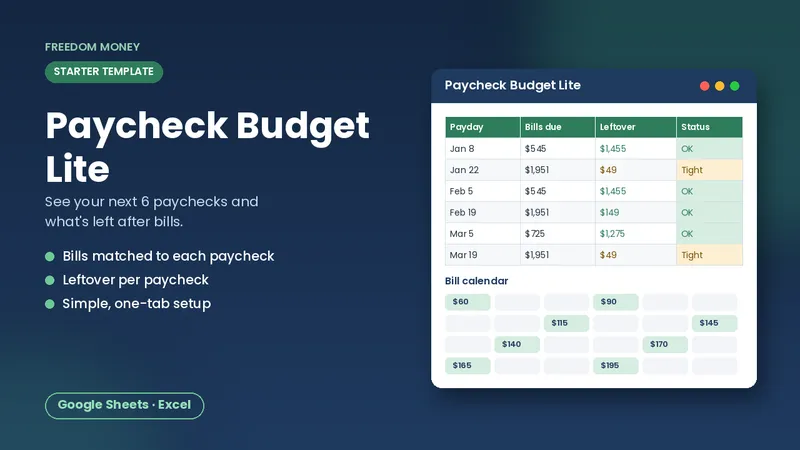
Free: Paycheck Budget Lite
A simple starter spreadsheet for Google Sheets or Excel. List your take-home pay and bills and see what each paycheck has left. Free, instant download.
Download the free templateStep 6: Give the leftover a job
Leftover money tends to vanish if it doesn't have a plan. Pick its job when you build the budget: an emergency cushion, extra debt payments, or a specific savings goal. A useful trick is to move the savings portion the same day you're paid, before anything else.
Handling the months with three paychecks
Because there are 26 biweekly paydays in most years, two months usually have three paydays. If your budget is built on two paychecks per month, that third paycheck is money with no bills assigned to it. Decide now what it does. See what to do with a 3-paycheck month for ideas.
What about when a paycheck is smaller?
Holidays, unpaid time off, or fewer hours can shrink a check. When you know it's coming:
- Look at that paycheck's assigned bills and see which are flexible.
- Lower that period's grocery and spending amounts a little.
- Pull from your buffer if you have one, then refill it from the next normal check.
- Call providers early if a bill can't be paid on time; asking before the due date usually gives you more options than calling after.
Tools that make this easier
You can do all of this on paper, but a spreadsheet saves time because the dates repeat every 14 days. In Google Sheets, list your first payday and add 14 days down a column to get every payday for the year. Then pair each bill's due date with the matching payday. Our Biweekly Paycheck Budget template does the matching automatically and flags paychecks that are "Short" or "Tight". If you want to try the idea first, the free Lite version covers one month.
A sample payday checklist
- Check that the deposit amount matches your plan.
- Pay or schedule every bill assigned to this paycheck.
- Transfer savings right away.
- Set aside grocery and gas money for the next 14 days.
- Peek at the next paycheck so you know what's coming.
Why this works
Budgeting by paycheck works because it lines your plan up with the way money actually moves through your account. You stop guessing whether there's "enough this month" and instead know exactly what each deposit has to cover. Most people find that after two or three cycles the stress drops noticeably, because there are no more surprise shortfalls the week before payday.
Keep it simple
The best budget is the one you'll keep using. Start with just your fixed bills and a grocery number. Add categories later once the habit sticks. Five minutes every payday beats a perfect spreadsheet you open once.
Frequently asked questions
What's the easiest way to budget a biweekly paycheck?
Assign each monthly bill to the paycheck that arrives right before its due date, subtract every-paycheck costs like groceries and gas, and give whatever is left a specific job.
Should I split rent between two paychecks?
If one paycheck can't comfortably cover rent, saving half of it from each paycheck in a separate account is a common, simple fix.
How much buffer should I keep?
Many people aim for a cushion equal to one paycheck's worth of bills. Once it's in place, due-date timing matters much less.
This guide is general educational information, not financial, tax, legal, or insurance advice. Examples are illustrations, not predictions. See our disclaimer.