Saving
What Are Sinking Funds? How to Save for Yearly Bills One Paycheck at a Time
Sinking funds explained in plain English: what they are, which yearly bills need one, how to work out the amount per biweekly paycheck, and how to keep them organized.
On this page
A sinking fund is a small pot of savings for one cost you already know is coming. Car registration, holiday gifts, an annual insurance premium, school supplies, a pet's yearly vet visit: none of these are surprises, but because they don't show up every month, they often feel like emergencies when they arrive. A sinking fund turns one big, stressful bill into a series of small, boring deposits.
This guide explains how sinking funds work, which costs deserve one, how to calculate the amount to set aside from each paycheck, and the simple habits that keep the system running.
Sinking funds in one sentence
Take the cost, divide it by the number of paychecks before it's due, and set that amount aside every payday so the money is waiting when the bill arrives.
That's the whole idea. The name comes from an old finance term for money a company sets aside regularly to repay a debt, but for a household it just means "saving ahead, on purpose, for a specific thing."
Sinking fund vs. emergency fund
People often mix these up, and keeping them separate is the point.
- An emergency fund is for things you can't predict: a job loss, an urgent medical bill, a sudden repair. You don't know when or how much. See our guide to building an emergency fund on a biweekly paycheck.
- A sinking fund is for things you can predict, at least roughly: you know the bill exists and about when it's due.
When predictable costs come out of the emergency fund, it shrinks again and again, and it's never there for a real emergency. Giving each known cost its own sinking fund protects the emergency fund for what it's meant for.
Which costs need a sinking fund?
Go through the last 12 months of bank and card statements and look for anything that doesn't happen every month. Common examples:
- Car: registration and tag renewal, inspections, tires, oil changes, a repair allowance
- Insurance: premiums paid every 6 or 12 months instead of monthly
- Holidays and birthdays: gifts, food, travel
- Kids: back-to-school clothes and supplies, sports fees, camp
- Home: HOA or annual dues, renter's insurance, small repairs, replacing appliances
- Health: deductibles, glasses and contacts, dental work
- Subscriptions billed yearly: memberships, software, warehouse club
- Personal: a vacation, a wedding you're attending, a new phone
You don't need all of these. Start with the three or four that caused the most stress last year. A good sign that something needs a sinking fund is that you remember it hurting.
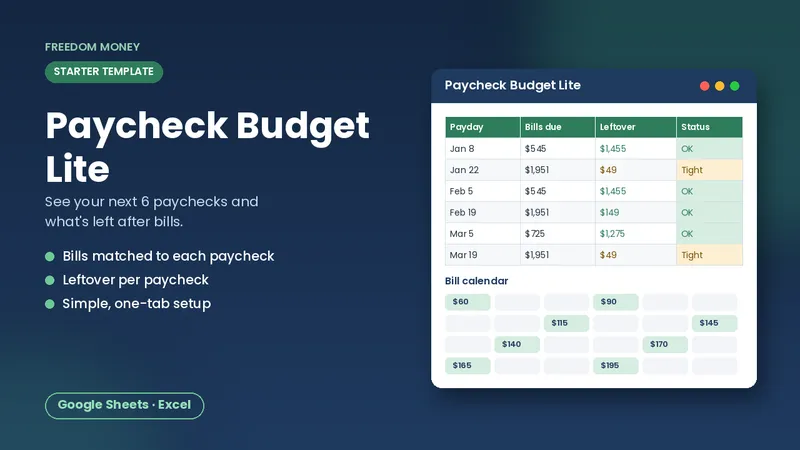
Free: Paycheck Budget Lite
A simple starter spreadsheet for Google Sheets or Excel. List your take-home pay and bills and see what each paycheck has left. Free, instant download.
Download the free templateHow to calculate the amount per paycheck
Here is the basic math for one fund:
- Target: how much the cost will be. Use last year's amount, rounded up a little.
- Already saved: anything set aside for it so far.
- Paychecks left: the number of paydays between today and the due date.
- Per paycheck = (Target − Already saved) ÷ Paychecks left.
Example. Say your car insurance renewal is $720 and it's due in 6 months. You've saved nothing yet. If you're paid every two weeks, there are about 13 paychecks in 6 months.
$720 ÷ 13 ≈ $55.38 per paycheck. Round up to $56 and you'll have a little cushion.
Now do the same for holiday gifts: $600 due in 10 paychecks is $60 per paycheck. School supplies: $250 due in 8 paychecks is about $32 per paycheck.
Add them up: $56 + $60 + $32 = $148 per paycheck. That's the number you build into your budget. It might look like a lot, but it's money you were going to spend anyway. The only difference is that you spread it out instead of finding it all at once.
If you're paid every two weeks
With a biweekly paycheck there are 26 paydays a year, and most months have two. If you set a fund's amount per paycheck, two months a year will have three paydays. You can either deposit as normal in those months (you'll get ahead) or skip the sinking fund deposit that one time. Our guide to three-paycheck months covers more ways to use them.
If the amount is too big
If the total doesn't fit, you have three honest options: lower the target (a smaller gift budget), move the due date later if you can, or start with only the funds that matter most and add more as other bills get paid off. It's fine to fund something partly. Having $300 saved when a $600 bill arrives is still far better than having $0.
Where to keep sinking fund money
You don't need a separate bank account for every fund. Some ways people do it:
- One savings account plus a tracker. All the money sits in one savings account, and a spreadsheet keeps track of how much of it belongs to each fund. This is the simplest option.
- Nicknamed sub-accounts. Some banks let you open several savings "buckets" in one account. If yours does, name each bucket after its fund.
- Separate accounts for big funds only. Keep a large fund, like a car replacement, in its own account and the rest together.
Whatever you choose, keep sinking fund money out of your everyday checking account so it doesn't get spent by accident. If you use a separate bank, check that it's FDIC-insured; the FDIC has a tool for this at fdic.gov.
Keeping it organized
The math is easy for one fund. It gets messy with eight funds, different due dates, and some that repeat every 6 months. A few habits help:
- Automate the transfer. Set a recurring transfer for the day after payday, for the total of all your sinking funds.
- Log every deposit and withdrawal. When you spend from a fund, record it so you know what's left.
- Review once a month. Check what's due in the next 60 days and whether each fund is on track.
- Roll the due date forward. After a yearly bill is paid, set next year's due date and start again.
You can do all of this with pen and paper or a basic spreadsheet. If you'd rather not build it yourself, our Sinking Funds Tracker does the per-month and per-paycheck math for up to 20 funds, rolls repeating due dates forward, and flags what's due soon. It's an organizing tool, so the results are only as good as the numbers you enter.
Common mistakes
- Too many funds at once. Ten funds at $5 each won't feel like progress. Start with a few and fund them properly.
- Borrowing between funds without writing it down. If you take from the vacation fund for a car repair, note it and plan to pay it back.
- Forgetting price changes. Insurance and registration fees change. Check the real amount each year and update the target.
- Using a sinking fund as an emergency fund. If something truly unexpected happens, that's what the emergency fund is for.
A simple way to start this week
- List three yearly costs that hurt last year.
- Write each target and due date.
- Divide to get the per-paycheck amount.
- Set up one automatic transfer on payday.
- Check in once a month.
That's it. Sinking funds won't raise your income, but they make your spending more predictable, and fewer bills catch you off guard. If you're also saving for bigger goals, see how to save for goals per paycheck.
This article is general education, not financial advice. Your numbers and situation are your own.
Frequently asked questions
What is a sinking fund?
Money you set aside a little at a time for a specific, expected cost, such as car registration or holiday gifts, so it's ready when the bill is due.
How is a sinking fund different from an emergency fund?
An emergency fund covers costs you can't predict. A sinking fund covers costs you know are coming. Keeping them separate protects your emergency money.
How much should I put in each sinking fund per paycheck?
Subtract what you've already saved from the target, then divide by the number of paychecks left before the due date.
Do I need a separate bank account for each sinking fund?
No. Many people keep all sinking funds in one savings account and use a spreadsheet to track how much belongs to each fund.
How many sinking funds should I have?
Start with the three or four costs that caused the most stress last year, and add more once those are funded.
This guide is general educational information, not financial, tax, legal, or insurance advice. Examples are illustrations, not predictions. See our disclaimer.