Saving
How Much to Save Each Paycheck for Christmas (Simple Sinking Fund Math)
Work out how much to set aside from each biweekly or monthly paycheck for Christmas gifts, travel, and food. Includes a clear formula, hypothetical examples, and how to keep the money separate.
On this page
- Why Christmas spending feels like an emergency
- Step 1: Decide what "Christmas" includes
- Step 2: Pick a total you can actually fund
- Step 3: Use the biweekly formula (and the monthly one)
- Step 4: Put the money somewhere you will not spend by accident
- Step 5: Shop from the fund, not from next month's paycheck
- Worked example: a tighter budget with kids
- What if you are starting late?
- Common mistakes
- A simple yearly rhythm
- Spreadsheet vs. app vs. cash
Christmas gifts, wrapping, travel, and parties do not sneak up on anyone. The date is the same every year. What sneaks up is the bill: people who spend from November credit cards often start January already behind. Setting aside a fixed amount from each paycheck turns one big December cost into a series of small deposits you barely notice.
This guide shows how to pick a realistic Christmas budget, work out the amount to save from each biweekly (or monthly) paycheck, and keep the money separate so it is there when you need it. The numbers below are hypothetical examples, not recommendations for your household.
Why Christmas spending feels like an emergency
A yearly cost that you do not prepare for feels like a surprise even when it is not. December hits at the same time as colder-weather utilities, year-end insurance, and (for many people) fewer overtime hours. Without a plan, the gap gets filled with credit cards. Interest then turns a one-month purchase into months of payments.
A Christmas sinking fund is simply money you set aside on purpose for holiday costs. It is the same idea as any other sinking fund: take the total you expect to spend, divide by the number of paychecks left before you need the cash, and move that amount every payday. For the broader method, see what sinking funds are and how they work.
Step 1: Decide what "Christmas" includes
Write a short list before you pick a dollar amount. Common categories:
- Gifts (each person on your list, with a rough cap)
- Wrapping, cards, and shipping
- Travel (gas, flights, hotels, or a longer drive to family)
- Food and hosting (extra groceries, a holiday meal, or parties)
- Kids' activities (school events, photos, costumes)
- Charitable giving you already plan to do in December
Leave out things you will buy anyway (regular groceries, rent). Include only the extra holiday spending. If last year you used a credit card, pull the December and early-January statements and add up the holiday charges. That total is a better starting point than a guess.
Step 2: Pick a total you can actually fund
Your Christmas budget has to fit the months you have left. In mid-October you might have about five biweekly paychecks before mid-December shopping. In January you have the whole year. Be honest about timing.
Hypothetical example (biweekly pay):
Alex wants a Christmas total of $600: $400 gifts, $80 wrapping and shipping, $70 extra food, $50 gas for a family trip. It is October 14. Alex's next payday is October 17, and shopping needs to start by December 12. That leaves four full paychecks (Oct 17, Oct 31, Nov 14, Nov 28) before the main shopping weekend.
Amount per paycheck = $600 ÷ 4 = $150.
If $150 per paycheck is too tight, Alex has three honest choices: lower the total (for example to $400, which is $100 per paycheck), start earlier next year, or spread shopping with cash already saved instead of adding new debt. Raising the Christmas budget without raising the deposits is how the credit card returns.
Step 3: Use the biweekly formula (and the monthly one)
Biweekly pay (26 paychecks a year):
If you start at the beginning of the year and want the money ready by early December, you have roughly 24 paychecks before mid-December (paychecks 1 through 24 of the year). Amount per paycheck ≈ Christmas total ÷ 24.
Example: $600 ÷ 24 = $25 per paycheck for the whole year. That is much easier than $150 with only four paychecks left.
If you are paid monthly (12 times a year) and start in January for a December goal: $600 ÷ 11 ≈ $55 per month (January through November).
If you are paid weekly, divide by the number of Fridays left before you need the cash.
For other goals (car repairs, insurance, school), the same math appears in how much to save per paycheck for a goal.
Step 4: Put the money somewhere you will not spend by accident
Options that work for most people:
- A separate savings account labeled "Christmas" (or "Holidays")
- A separate line in your budget spreadsheet with a running balance
- A cash envelope only if you can keep cash safely and will not "borrow" from it
Autopay a transfer on payday if your bank allows it. The point is that the money leaves your checking account before you treat it as available for groceries or online shopping.
Track deposits and the remaining balance so you know when you are on pace. A simple spreadsheet row works: date, deposit, balance, notes. If you prefer a ready-made sheet that handles Christmas plus other yearly costs, the Sinking Funds Tracker plans up to 20 funds and shows the amount per month and per biweekly paycheck. Prefer to start free? The Paycheck Budget Lite helps you see what each paycheck still has after bills.
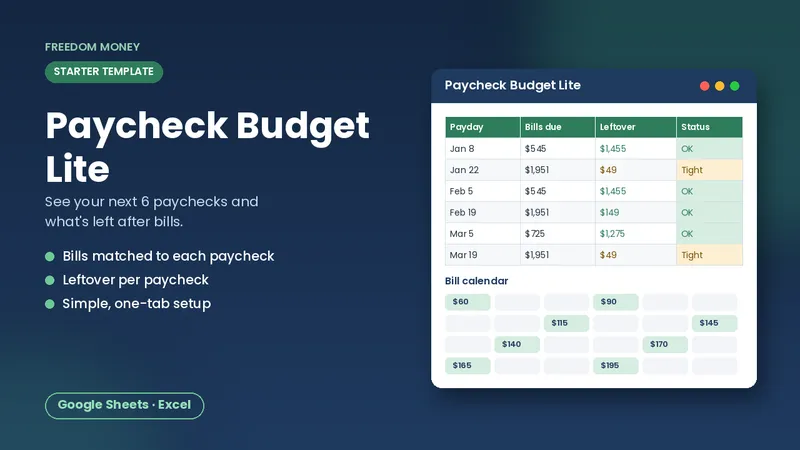
Free: Paycheck Budget Lite
A simple starter spreadsheet for Google Sheets or Excel. List your take-home pay and bills and see what each paycheck has left. Free, instant download.
Download the free templateStep 5: Shop from the fund, not from next month's paycheck
When you buy a gift, pay from the Christmas account or mark the spend against that line in your sheet. Do not "float" purchases on a credit card unless you will pay the card in full from the fund the same week. Floating is how a planned $600 Christmas becomes a $600 balance plus interest in January.
Halfway check: if you are two paychecks in and have only half of what the plan required, either cut the gift list now or increase the next deposits. Waiting until December 20 to notice a shortfall forces last-minute credit use.
Worked example: a tighter budget with kids
Hypothetical: Jordan has three kids and relatives to buy for. Last year holiday spending was about $900 on cards. Jordan starts saving on January's first paycheck and wants cash ready by December 1.
- Pay schedule: biweekly
- Paychecks before December 1: about 24
- Target: $720 this year (lower than last year on purpose)
- Per paycheck: $720 ÷ 24 = $30
Jordan also sets a simple gift cap: $100 per child, $40 per adult relative, and $50 for teacher/class gifts, with the rest for wrapping and one family activity. When a sale appears in October, Jordan spends from the fund only if the balance covers it. By December 1 the sheet shows $720 saved; shopping stays inside that number.
What if you are starting late?
Starting in October or November is still better than starting on December 10 with a credit card. Do this:
- Add up last year's holiday charges (or a realistic list).
- Count the paychecks left before you must spend.
- Divide. If the per-paycheck amount crowds out rent or groceries, cut the total until the deposit fits.
- Tell anyone who needs to know that gifts will be smaller this year. Most people prefer an honest smaller gift to a stressed January.
You can also split the difference: save what you can in cash, and only use a card for a fixed leftover you can repay from the first January paycheck. Write that repayment on your bill calendar so it does not get forgotten.
Common mistakes
- No written total. Without a number, every "small" purchase adds up.
- Saving in the same checking account. The money looks spendable and disappears.
- Starting from a Pinterest wishlist instead of last year's statements. Wishlists inflate; statements show what you actually did.
- Ignoring travel and food. Gifts are only part of the cost.
- Calling it done in December and skipping January. The best Christmas fund starts when the decorations come down.
A simple yearly rhythm
- January: Open or reset the Christmas fund. Set the autopay amount from Step 3.
- Spring and summer: Leave it alone except for the automatic deposits.
- October: Confirm the balance vs. your list. Adjust gifts if needed.
- November–December: Spend only from the fund. Stop when the balance hits your planned floor (some people leave $0; others leave a small cushion for next year).
- Early January: Note what you actually spent. That number becomes next year's target.
Pair the Christmas line with your regular paycheck plan so deposits do not collide with rent week. Guides on budgeting biweekly paychecks and three-paycheck months help you choose which payday feeds the fund.
Spreadsheet vs. app vs. cash
- Spreadsheet: free, private, and clear. You see the target, deposits, and remaining balance in one place. Google Sheets works on a phone.
- Bank "buckets" or sub-accounts: convenient if your bank supports labeled savings; still track the target yourself.
- Cash envelope: visible, but risky to store and easy to borrow from.
- Store credit or buy-now-pay-later: usually the opposite of a sinking fund. You get the item now and the bill later, often with fees.
If you already use a paycheck budget, add one line called Christmas (or Holidays) and treat the deposit like a bill you pay yourself. The free budget template is enough to test the habit before you add a full sinking-funds sheet.
This article is general education, not financial advice. Always check amounts and due dates against your actual statements.
Frequently asked questions
How much should I save per paycheck for Christmas?
Divide your total Christmas budget by the number of paychecks left before you need the cash. Starting in January on biweekly pay, a $600 total is about $25 per paycheck (600 ÷ 24). Starting in mid-October with only four paychecks left, the same $600 is $150 per paycheck.
When should I start a Christmas sinking fund?
January is easiest because the per-paycheck amount is smallest. Starting later still helps if you cut the total to match the paychecks you have left.
Should Christmas savings go in a separate account?
Yes if you can. A labeled savings account or a separate line in a spreadsheet keeps the money from looking like spare checking-account cash.
What if I cannot afford the per-paycheck amount?
Lower the Christmas total until the deposit fits after rent, food, and required bills. A smaller cash Christmas beats a larger one paid with high-interest debt.
Is a Christmas fund the same as an emergency fund?
No. An emergency fund is for costs you cannot predict. A Christmas fund is for a date and cost you can plan for. Keep them separate so holiday spending does not drain emergency savings.
This guide is general educational information, not financial, tax, legal, or insurance advice. Examples are illustrations, not predictions. See our disclaimer.