Saving
How Much to Save Per Paycheck for a Goal (With a Simple Formula)
Work out exactly how much to save per paycheck or per month for any goal, using one simple formula. Includes sinking funds, worked examples, and tracking tips.
On this page
- The formula
- Counting paychecks left
- Sinking funds: saving for costs you know are coming
- Juggling several goals at once
- Where to keep the money
- Automate it
- Tracking progress
- What if you fall behind?
- A worked plan with three goals
- The bottom line
- Quick reference: yearly costs to per-paycheck amounts
- Celebrate milestones
"Save more" is a wish. "Save $46 every paycheck until June" is a plan. The difference is one small calculation. This guide shows how to work out exactly how much to set aside for any goal, how to juggle several goals at once, and how to keep track without it becoming a chore.
The formula
Amount per paycheck = (Goal amount − Already saved) ÷ Paychecks left before the deadline
That's it. For monthly saving, use months left instead of paychecks left.
Example 1: a holiday fund
You want $900 for the holidays by December 1. You've saved $150. There are 12 biweekly paychecks between now and then.
($900 − $150) ÷ 12 = $62.50 per paycheck.
Example 2: car repairs
You want a $1,200 car-repair fund in 10 months and have nothing saved yet. Monthly: $1,200 ÷ 10 = $120 per month. If you're paid biweekly, that's roughly 21–22 paychecks in 10 months, so about $55–$57 per paycheck.
Counting paychecks left
If you're paid biweekly, don't just multiply months by two. Months with three paydays add extra paychecks (see three-paycheck months). The accurate way is to list paydays from today to your deadline. In a spreadsheet, start with your next payday and add 14 days down a column, then count how many fall before the goal date with =COUNTIF(range,"<"&deadline).
Sinking funds: saving for costs you know are coming
A sinking fund is just a savings goal for an expense you know is coming, even if the exact date is fuzzy. Typical sinking funds:
- Car maintenance and tires
- Holidays and birthdays
- Annual subscriptions and memberships
- Back-to-school costs
- Vehicle registration and insurance premiums paid yearly
- Medical deductibles and co-pays
- Home or renter costs like moving or replacing an appliance
The trick is to stop treating these as surprises. They're bills that happen to arrive once a year. Divide each yearly amount by 26 (or 12) and save that every paycheck.
Juggling several goals at once
Most people have three to six goals at a time. A simple way to prioritize:
- Deadline goals first. If a cost is coming on a specific date, it gets funded on schedule.
- A starter emergency cushion next, so a surprise doesn't land on a credit card. See emergency fund on biweekly pay.
- Open-ended goals last, like a bigger emergency fund, a future car, or a trip with no fixed date.
Add up the per-paycheck amounts. If the total is more than your budget allows, push back a deadline, lower a target, or pause an open-ended goal until a deadline goal is done.
Where to keep the money
Many people use one savings account and track goals in a spreadsheet. Others prefer separate accounts or "buckets" if their bank offers them. Either works as long as you know how much of the balance belongs to each goal. Keep savings out of your everyday checking so it isn't spent by accident. If your bank pays interest on savings, that's a bonus, but convenience and safety matter more for short-term goals. Make sure the account is FDIC-insured (or NCUA-insured for credit unions); you can learn about deposit insurance at fdic.gov.
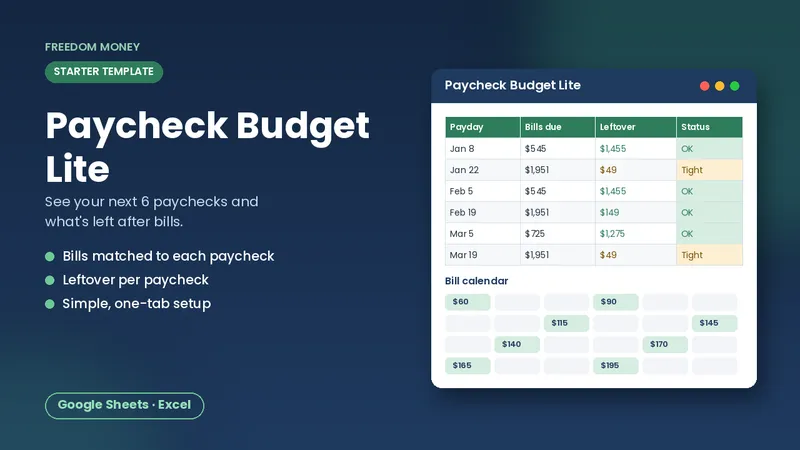
Free: Paycheck Budget Lite
A simple starter spreadsheet for Google Sheets or Excel. List your take-home pay and bills and see what each paycheck has left. Free, instant download.
Download the free templateAutomate it
The most reliable savers don't rely on willpower. Set an automatic transfer for the day after payday, for the total of your per-paycheck amounts. Then update the tracker each payday to split that transfer across goals.
Tracking progress
A good tracker shows, for each goal:
- Target amount and deadline
- Saved so far
- Percent complete (with a progress bar if you like)
- Months or paychecks left
- Amount needed per month and per paycheck to finish on time
When something changes, like you skip a paycheck's transfer, the "needed per paycheck" number updates and tells you how to catch up. Our Savings Goals Tracker calculates all of this automatically, including progress bars and the per-biweekly-paycheck amount.
What if you fall behind?
- Recalculate with the formula using the real saved amount and real paychecks left.
- Use a windfall, like a tax refund or three-paycheck month, to catch up.
- Move the deadline if it's flexible. Saving steadily at a lower amount is better than quitting.
- If you had to spend from a goal for a real emergency, that's what savings is for. Restart the plan without guilt.
A worked plan with three goals
| Goal | Target | Saved | Paychecks left | Per paycheck |
|---|---|---|---|---|
| Holidays | $900 | $150 | 12 | $62.50 |
| Car repairs | $1,200 | $0 | 22 | $54.55 |
| Starter cushion | $1,000 | $300 | 20 | $35.00 |
Total: about $152 per paycheck. If that's too much, you might push the cushion out a few months and save $25 per paycheck toward it instead.
The bottom line
Every savings goal comes down to one formula: what's left to save divided by the time left to save it. Write your goals down, calculate the per-paycheck amount, automate the transfer, and check progress each payday. Small, specific, automatic amounts beat big intentions.
Quick reference: yearly costs to per-paycheck amounts
Dividing by 26 gives a steady per-paycheck amount for any yearly expense:
| Yearly cost | Per biweekly paycheck | Per month |
|---|---|---|
| $260 | $10.00 | $21.67 |
| $520 | $20.00 | $43.33 |
| $780 | $30.00 | $65.00 |
| $1,300 | $50.00 | $108.33 |
| $2,600 | $100.00 | $216.67 |
Add up your yearly costs, find the closest row, and you'll know roughly what to set aside. If you start partway through the year, use the formula with the real number of paychecks left instead.
Celebrate milestones
Long goals can feel slow. Break them into milestones, like 25%, 50%, and 75%, and mark each one when you hit it. A progress bar in your tracker makes the milestones visible. Small rewards that don't undo the progress, like a favorite meal at home, can help keep you motivated until the goal is fully funded. When you finish a goal, roll its per-paycheck amount into the next goal on your list, just like a debt snowball.
Frequently asked questions
How do I calculate how much to save per paycheck?
Subtract what you've already saved from the goal, then divide by the number of paychecks left before your deadline.
What is a sinking fund?
A savings goal for an expected cost, like car repairs or holidays, that you fund a little at a time so it doesn't become a surprise.
Should I have separate savings accounts for each goal?
It's optional. One account plus a tracker works fine as long as you know how much belongs to each goal.
This guide is general educational information, not financial, tax, legal, or insurance advice. Examples are illustrations, not predictions. See our disclaimer.