Moving
Moving to South Florida With Kids: A Practical Checklist
A step-by-step checklist for families moving to Miami-Dade, Broward, or Palm Beach County: rent benchmarks, school enrollment forms, utilities, license deadlines, and hurricane prep.
On this page
South Florida (Miami-Dade, Broward, and Palm Beach counties) has beaches, big school districts with lots of programs, and year-round sun. It also has details that catch newcomers off guard: flood zones, hurricane season, short deadlines for licenses and tags, and water service that sometimes has to be opened by the property owner. This checklist covers what families should handle before and after the move, with official sources for each step.
Before you choose a home
- Check rent against an official benchmark. HUD's Fair Market Rents are a stable yardstick (they're gross rents including basic utilities, not quotes). For FY2027 (from October 1, 2026), HUD lists 3-bedroom FMRs of $3,277 for the Miami-Miami Beach-Kendall area (Miami-Dade), $3,172 for the Fort Lauderdale area (Broward), and $3,052 for West Palm Beach-Boca Raton (Palm Beach). Source: HUD User.
- Look up the FEMA flood zone for any address at msc.fema.gov. Flood zones can change block by block.
- Look up the evacuation zone at floridadisaster.org/knowyourzone. Evacuation zones (storm surge) and flood zones (insurance risk) are different, so check both.
- Ask who opens the water account. In some cities, including Fort Lauderdale, Pembroke Pines, and Jupiter, the owner must. In Coral Springs, one of four providers may serve the address.
- Ask about storm protection: impact windows or shutters, and who installs them.
- Get insurance quotes before you commit, including renters or homeowners and flood.
Schools
All three districts earned an A from the Florida Department of Education for both 2024–25 and 2025–26, according to FLDOE school grades results. Individual school grades vary within each district, so look up your zoned school with your district's boundary locator and open its report card at edudata.fldoe.org.
District websites: dadeschools.net (Miami-Dade), browardschools.com (Broward), palmbeachschools.org (Palm Beach).
Health documents for students entering a Florida school for the first time (Florida Department of Health; Fla. Stat. 1003.22):
- A school-entry health exam completed within the past 12 months. Form DH 3040 is recommended but not required; an out-of-state exam with the required components is accepted.
- Florida Certification of Immunization, form DH 680. Bring complete shot records to a Florida doctor or your county health department.
Start these early; they're a common cause of first-day delays.
Enrollment checklist:
- Birth certificate or other proof of age
- Proof of address (each district sets its own list)
- Health exam and DH 680
- Latest report card, withdrawal form, and transcripts for older students
- IEP, 504, gifted, or English-learner records if any
- Custody paperwork if it applies
Licenses, titles, and tags
Florida's deadlines are short. According to FLHSMV, you have 10 days to register vehicles after establishing residency, starting a Florida job, or enrolling a child in public school (whichever comes first), and 30 days to get a Florida driver license after establishing residency. Details: flhsmv.gov/new-resident. See our full guide: Florida driver license after moving.
Utilities and internet
- Electric: Florida Power & Light (FPL) serves most of the three counties. Some addresses in Homestead are served by Homestead Energy Services.
- Water: depends on the city. Miami-Dade Water and Sewer serves much of Miami-Dade. In Palm Beach County, use the county's Find Your Provider tool at discover.pbc.gov/waterutilities.
- Internet: check every provider at your exact address on the FCC National Broadband Map.
- Mail forwarding: usps.com/move.
Hurricanes and flood
- The Atlantic hurricane season runs June 1 to November 30.
- Make a family plan: evacuation zone, flood zone, where you'd go, an out-of-town contact, a pet plan.
- Florida permanently exempts many disaster-preparedness items from sales tax since August 1, 2025, including common batteries, portable generators (10,000 running watts or less), tarps, smoke and carbon monoxide alarms, and fire extinguishers (Florida Department of Revenue, TIP 25A01-05).
- NFIP flood insurance typically has a 30-day waiting period, so buy it early. Renters can get contents coverage. See Florida flood insurance for renters.
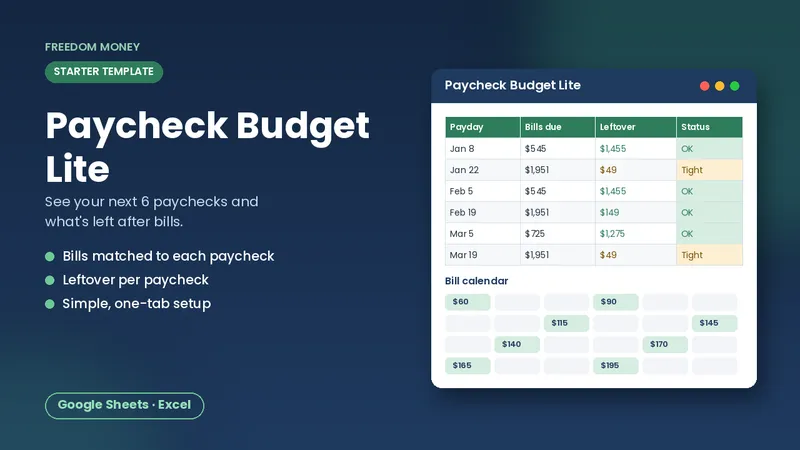
Free: Paycheck Budget Lite
A simple starter spreadsheet for Google Sheets or Excel. List your take-home pay and bills and see what each paycheck has left. Free, instant download.
Download the free templateTaxes and costs
- Florida has no state personal income tax.
- Combined sales tax in 2026: 7% in Miami-Dade and Broward, 6.5% in Palm Beach (Florida Department of Revenue, DR-15DSS).
- Newcomer surprises: insurance premiums, association fees, air conditioning most of the year, and tolls.
Movers
For an interstate move, check the mover's USDOT number and review your rights at the FMCSA's Protect Your Move site. Get at least three written estimates and ask whether each is binding.
Your first 30 days
- Florida auto insurance, VIN verification, then title and registration within 10 days
- Driver licenses within 30 days
- School enrollment with health forms
- Utilities and internet set up
- Evacuation and flood zones written on the fridge
- Hurricane kit started
- Voter registration updated (Florida Division of Elections, dos.fl.gov/elections)
Budget the move
Moves cost more than expected: deposits, overlapping rent, fees, and a hurricane kit. A paycheck-by-paycheck plan helps; see how to budget biweekly paychecks.
Want everything in one place?
The South Florida Family Move Kit is a 56-page guide with area-by-area notes for ten family-friendly areas, a neighborhood cheat sheet, and a move budget planner, with every figure traced to an official source.
A simple week-by-week order for your first month
- Week 1: Florida auto insurance, VIN verification, and an appointment with the county tax collector. Electric and water service confirmed. Hurricane plan and zones on the fridge.
- Week 2: Titles and tags (inside the 10-day window), school enrollment with health forms, internet installed.
- Week 3: Driver licenses for every driver, voter registration updated, renters or homeowners and flood insurance reviewed.
- Week 4: First month of real bills entered into your budget, old state's registration and insurance cancelled once Florida coverage is active.
Plan for summer heat and storms with kids
South Florida summers are hot and humid, and afternoon thunderstorms are common. If you're moving with kids in summer, plan for breaks during the hottest part of the day, keep water and snacks within reach, and pack a small "first night" bag for each child with clothes, chargers, and a comfort item. Since summer also falls within hurricane season, keep your family plan, important documents, and a basic kit easy to reach from day one rather than packed deep in a moving box.
Frequently asked questions
How long do I have to get a Florida driver license after moving?
FLHSMV says new residents have 30 days after establishing residency, and 10 days to register vehicles.
What forms does my child need to start school in Florida?
A school-entry health exam within the past 12 months and a Florida Certification of Immunization (DH 680).
When is hurricane season in South Florida?
The Atlantic hurricane season runs from June 1 to November 30.
This guide is general educational information, not financial, tax, legal, or insurance advice. Examples are illustrations, not predictions. See our disclaimer.